The word “icon” gets tossed around somewhat mindlessly these days. But when we say that this person was an icon, we mean it in every sense of the word. He was an icon within his family, within his community and within the Montgomery area as a whole. He was an icon to both the leaders of government and the trailblazers of the Civil Rights Movement. He was an icon to broadcasters with whom he worked and to a younger generation of broadcasters who have learned about him. Norman Lumpkin was … is a true icon, and the ABA is honored to induct him into the Alabama Broadcasters Association’s Hall of Fame.
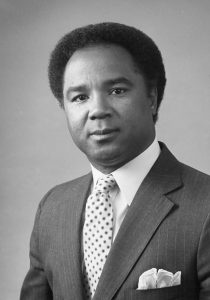 Lumpkin was working in Indianapolis when he was hired to join the staff of WSFA-TV in 1969, becoming the first African American television news reporter in the capital city. He mentored many young journalists over the years and was highly regarded by those who worked closely with him.
“I was a new cameraman. And he was so gracious in helping me know how to look for the shots he needed,” says Jeff Harrison, currently operations manager at WFSA-TV. “What I remember most about Norman is just the simple way he approached the story. There was no pomp and circumstance with Norman. He was there for the facts. You asked the questions and got the answers, and you moved on.”
“His philosophy on reporting was that he wanted it to be accurate, and he wanted it to be true,” says Dean Argo, a former WFSA reporter. “He wanted the viewer to understand what’s happening, but then to form an opinion and decide what their response would be to that story. Did they need to change their perspective? Did they need to contact their local official? Did they need to become more involved in the community? And so, his philosophy was, ‘I’m not on here to entertain you. I’m on here to educate you’”.
“Norman could feel the pulse of the community. He knew what was going on in the streets. He knew the back-channel chatter,” says Harrison. “He definitely was a trailblazer especially for TV journalism.”
Unlike other broadcasters, Lumpkin had a unique and complicated relationship with Governor Wallace.
“I think they (the governor’s office) originally expected Norman’s attitude and his writing would show his perspective on what was going on. But Norman didn’t do that,” explains Argo.
Lumpkin confided in Arlo that keeping his opinions at bay was difficult.
“It was very hard for him but that was one of the things that really helped Norman achieve such a high level of success. When he covered a story, it was never from a bias”.
In 1992, Norman Lumpkin left WSFA to become the news director for ABC affiliate WAKA in Montgomery. He left television and joined the Alabama Department of Transportation as a spokesperson in 1999, where he later retired. Lumpkin was inducted into the National Academy of Television Arts and Sciences prestigious Silver Circle in 2007. He passed away at the age of 75 in 2014.
Todd Towns, one of Lumpkin’s nephews, says his work ethic and philosophy ran parallel to those he shared with his family.
“He taught us that there might be some challenges and there might be some struggles, but there’s a way,” says Towns. “Keep your word. Don’t make excuses. And get it done. Complete the work.”
“Growing up I would see him on WSFA, and I was like wow! That’s my uncle on TV! And I’d think, ‘I can do anything!’”
“He was devoted to his family and a fierce defender of his people,” Towns continues. “He stood for something, and he looked for the best in you.”
“He gave me freedom. Freedom not to be afraid – not to doubt. He kicked doors down for me, for our family. That’s what he gave us. And that is powerful … he was the man.”